Opinion: Stop Giving Away Your Most Valuable Asset, Now!
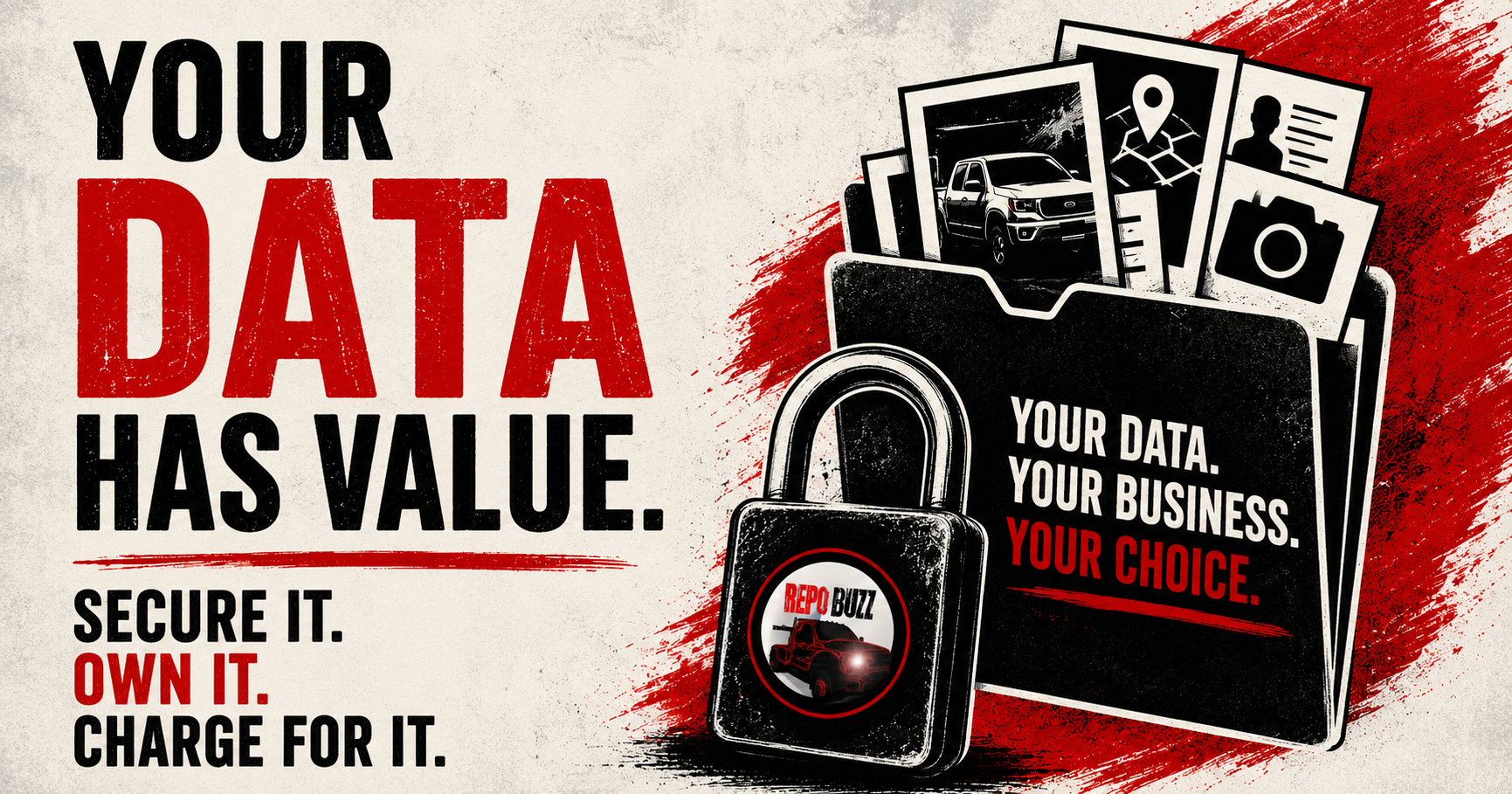
For decades, repossession agency owners have understood the value of tangible assets. They know the cost of a truck before it ever hits the road. They know what a wheel-lift costs, what insurance costs, what fuel costs, and what it takes to build a secure storage lot. Every piece of equipment has a price tag attached to it, and every successful agency owner understands the importance of protecting those investments.
What many agencies have failed to recognize, however, is that one of the most valuable assets they possess today cannot be parked in a lot, locked in a building, or financed through a bank. It exists inside computers, servers, mobile applications, cloud platforms, and databases. It is generated every day by agents in the field, office staff behind desks, cameras mounted on trucks, and software systems recording every action taken throughout the recovery process.
That asset is data.
The repossession industry is sitting on a mountain of valuable information, yet many agencies continue to give it away without ever stopping to ask who owns it, who has access to it, who profits from it, and what it may ultimately be worth.
Every recovery generates information. Every account update creates information. Every photograph taken in the field creates information. Every condition report, inventory record, debtor interaction, GPS coordinate, vehicle sighting, recovery timestamp, transport update, and storage event adds another layer to an increasingly valuable collection of operational intelligence. Individually, these pieces of information may seem insignificant. Collectively, they represent one of the largest repositories of collateral-related intelligence in the country.
The modern repossession industry has become heavily dependent on technology. Assignment management systems, mobile applications, inventory platforms, compliance tools, camera systems, license plate recognition networks, and auction integrations have become deeply embedded into daily operations. Agencies rely on these systems because they make work faster, more organized, and more efficient. There is nothing inherently wrong with that. In fact, technology has helped professionalize the industry in ways that would have been unimaginable twenty years ago.
The problem is not the technology itself. The problem is that many agency owners have never taken the time to understand what happens to their data once it enters those systems.
For years, the industry has focused almost exclusively on the cost of software. Agencies compare subscription fees, onboarding expenses, user licenses, and transaction charges. They negotiate pricing and evaluate features. Yet very few ask what may be the most important question of all.
What exactly are they receiving in exchange for the information they contribute?
Every day, agencies upload recovery photographs, vehicle condition reports, inventory documentation, account updates, location intelligence, and operational metrics into systems they do not own and do not control. Those systems may provide valuable services in return, but the information remains valuable regardless of where it is stored.
In virtually every other industry, data has become a recognized asset. Technology companies build billion-dollar valuations around information. Marketing firms monetize customer behavior. Analytics companies aggregate data and transform it into products. Artificial intelligence systems consume massive quantities of information to create new tools and services. Investors understand the value of data. Executives understand the value of data. Entire industries have been built around the collection, analysis, and monetization of data.
The repossession industry, meanwhile, continues to generate enormous amounts of valuable information while rarely considering whether it should be treated as an asset at all.
This issue becomes even more important when consumer information enters the discussion.
Repossession agencies routinely handle debtor names, addresses, phone numbers, vehicle information, account details, photographs, personal property documentation, and recovery-related records. Agencies operate under contractual obligations, confidentiality requirements, lender expectations, and a growing patchwork of state and federal privacy standards. Regardless of the specific legal framework involved, one principle remains universally accepted: access to sensitive information should be limited to those who have a legitimate business need for that information.
That principle should not be controversial.
Agency owners should know who has access to their information. They should know what information is being shared. They should know whether third parties can view it, whether integrations expose it, whether it is retained indefinitely, and whether it is used for purposes beyond the original recovery assignment.
Those questions are not accusations. They are simply good business.
Unfortunately, many agencies have spent years clicking “Accept” on user agreements without reading them. They have adopted platforms, enabled integrations, and uploaded hundreds of thousands of records without fully understanding the rights granted to software providers and their business partners. In many cases, agency owners know more about the warranty coverage on a truck than they do about the terms governing the data generated by their own operations.
That has to change.
The future of the repossession industry will be shaped not only by who recovers the most vehicles, but by who controls the most valuable information. Agencies are generating data that can reveal recovery trends, geographic patterns, vehicle condition histories, operational performance metrics, transport activity, storage timelines, and countless other forms of business intelligence. That information has value. Real value.
The question every agency owner should begin asking is simple: if someone else receives value from my data, why am I not being compensated for it?
That question may make some people uncomfortable, but it deserves an answer.
If recovery photographs create value beyond the recovery itself, that value should be recognized. If condition reports create value, that value should be recognized. If operational metrics create value, that value should be recognized. If information generated by agencies helps power analytics, reporting, artificial intelligence systems, remarketing tools, or other commercial products, agencies have every right to understand how that relationship works and whether they should share in the benefits.
For too long, the repossession industry has viewed itself strictly as a service business. Recover the vehicle. Complete the assignment. Send the invoice. Move on to the next account.
But the industry is no longer just moving vehicles. It is producing information. Massive amounts of information. And information has become one of the most valuable commodities in the modern economy.
Agency owners who fail to recognize this reality risk surrendering a valuable business asset without ever realizing what they have given away. Those who embrace it, however, may discover entirely new opportunities to strengthen their businesses, negotiate from a position of greater knowledge, and protect the information they work so hard to create.
None of this means agencies should stop using technology. Technology remains essential to modern recovery operations. It improves efficiency, enhances communication, and helps agencies compete in an increasingly complex marketplace. The goal is not to reject technology. The goal is to approach it with open eyes.
Ask questions. Read agreements. Understand permissions. Know who has access. Understand how information flows through the systems you use every day. Most importantly, begin viewing data as an asset rather than a byproduct.
Because the companies that dominate the next decade of the repossession industry may not be the ones with the biggest fleets or the largest coverage areas. They may be the ones that understand a simple truth before everyone else does.
The trucks create revenue.
The data creates value.
And value should never be given away for free.
Dave Branch