Using ALPR in California? You’re Required To Have This!
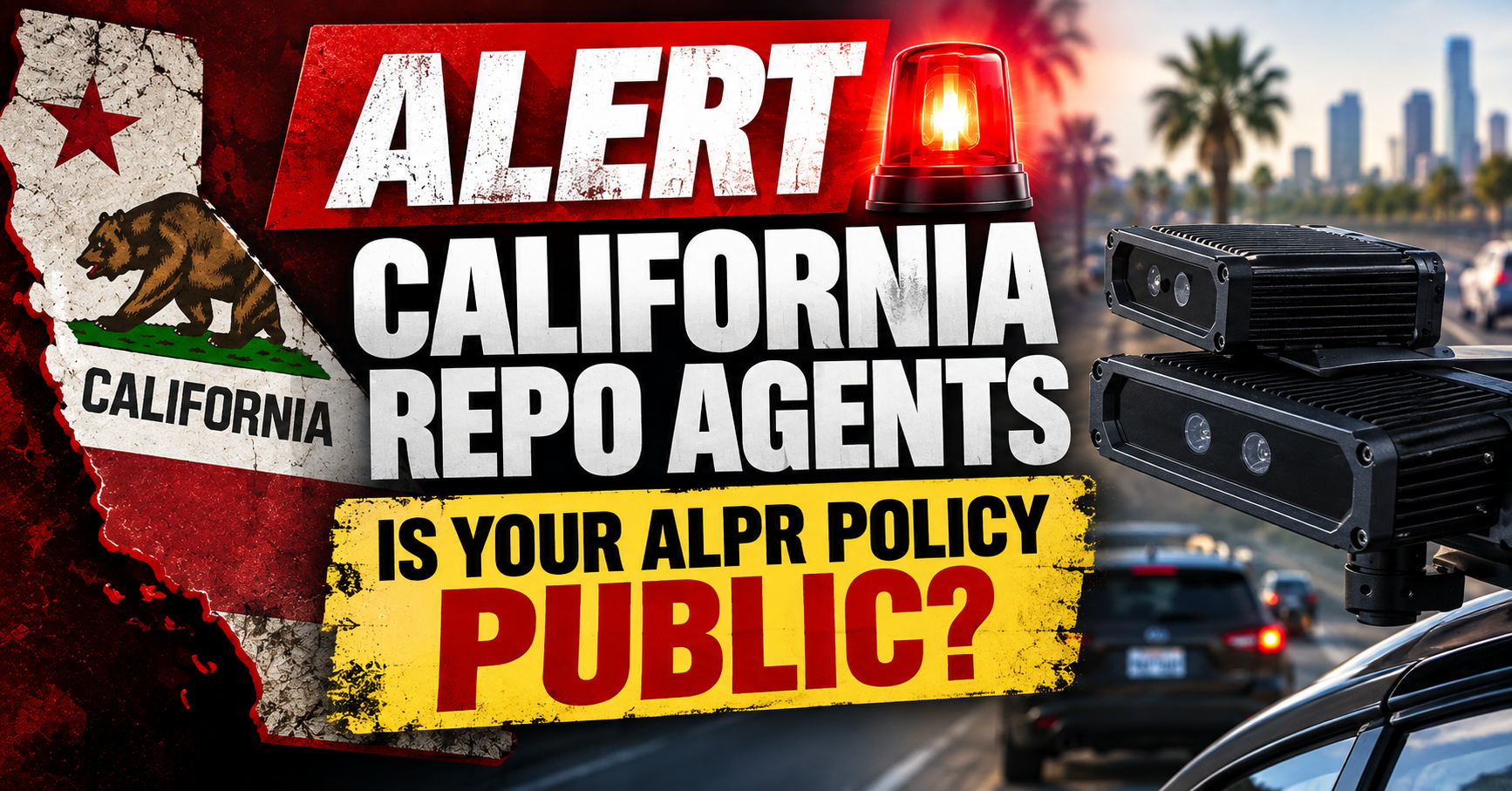
There is a good chance that many California repossession agencies using license plate recognition technology have an ALPR compliance problem—and may not even know it.
California Civil Code §1798.90.51 requires ALPR operators to implement a written usage and privacy policy covering authorized uses, authorized personnel and training, monitoring, sharing, data security, retention, destruction, and other required safeguards.
California Civil Code § 1798.90.53 requires any Automated License Plate Reader (ALPR) end-user or operator to maintain reasonable security procedures and practices and implement a usage and privacy policy.
The law also requires that policy to be made available to the public in writing. For an agency with a website, the policy must be posted conspicuously on that website.
That last part is easy to overlook.
We recently reviewed the websites of California repossession agencies that publicly advertise their use of LPR technology. In the agencies we reviewed, we could not locate a publicly posted California ALPR Usage and Privacy Policy anywhere.
That doesn’t necessarily mean those companies don’t have a policy sitting in an office or stored on a computer. It does, however, raise an obvious question: if the law requires the policy to be publicly available—and conspicuously posted on the website when the agency has one—can a member of the public actually find it?
This isn’t just a theoretical question.
The California Court of Appeal recently considered the state’s ALPR requirements in Mata v. Digital Recognition Network, Inc. The case involved allegations concerning the use of ALPR information, and the court’s discussion provides an interesting look at the importance of the statutory policy requirements.
DRN was able to point to a written California ALPR policy that addressed the requirements of the law and was publicly posted on its website. The court specifically discussed the policy, including its authorized uses, provisions concerning users and training, monitoring and audits, and other safeguards. The court ultimately affirmed judgment in DRN’s favor because the plaintiff failed to establish the actual harm necessary to pursue the claim.
Repo Buzz previously reported on the case, and it is worth revisiting for anyone operating ALPR technology in California.
There is another reason California agencies should pay attention. The state’s ALPR law provides a civil remedy for certain knowing violations. A person who is harmed may bring an action, with liquidated damages of at least $2,500, along with the possibility of additional damages, attorney’s fees and costs.
In other words, the question isn’t whether an agency thinks it needs an ALPR policy. California law says it does.
The more important question is whether the agency has the right policy, whether its employees and contractors understand it, whether the agency follows it, and whether the public can actually find it.
No clue how to begin building your compliance program or even what to put in it? That is where RepoForms comes in.
The California ALPR Compliance Policy & Procedure Package from RepoForms was developed specifically for the repossession industry and has been designed to address the California requirements while giving an agency an actual framework for controlling and documenting its use of ALPR information. And RepoForms fully customizes your P&P docs and they are ready to implement right out of the box.
Search for your ALPR policy.
If you can’t find it, don’t assume you’re covered simply because you have an LPR account.
Get the policy in place. Make sure it addresses what California requires. Put it where the public can find it. And make sure your agency is actually following it.
This is one piece of your compliance file you don’t want to discover is missing after someone else discovers it first.
Get your ALPR policy in place. Get it updated. And protect your agency.
If You Don’t Get It From RepoForms,
Get It From Somewhere!
California Specific
All Other States