Three Governors. One Growing Problem for LPR
The backlash against networked automated license plate recognition is no longer confined to privacy advocates or one political party. Three Republican and Democratic governors have now taken notably different but significant steps toward greater scrutiny of the technology, signaling that the political environment surrounding LPR may be changing rapidly.
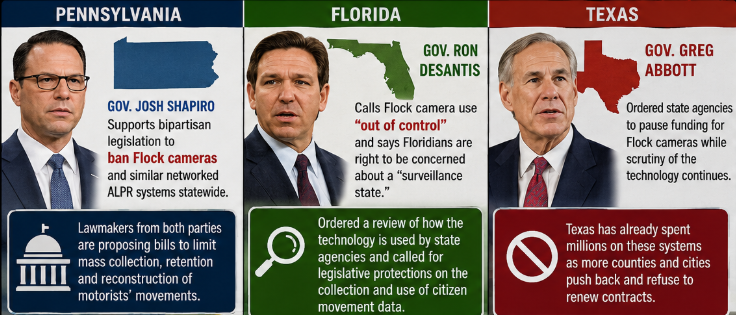
In Pennsylvania, Gov. Josh Shapiro has said he would support bipartisan legislation banning Flock cameras and similar networked ALPR systems statewide. His comments come as Pennsylvania lawmakers from both parties prepare proposals targeting mass collection, retention and reconstruction of motorists’ movements. One Republican proposal specifically targets the searchable networks created by companies such as Flock, while another would prohibit routine, suspicionless tracking while preserving targeted law-enforcement uses.
In Florida, Republican Gov. Ron DeSantis has taken an unusually blunt position, calling the proliferation of Flock cameras “out of control” and saying Floridians are right to be concerned about becoming a “surveillance state.” DeSantis has ordered a review of how the technology is being used by state agencies and called for legislative protections addressing the collection and use of citizens’ movement data. He made clear that he supports giving police tools to fight crime, but sees a difference between investigating criminals and continuously tracking ordinary Floridians.
Texas has taken perhaps the most concrete action of the three. Gov. Greg Abbott has ordered state agencies to pause funding for Flock cameras while scrutiny of the technology continues. Texas has already spent millions of dollars supporting these systems, and the governor’s action comes amid growing opposition in several counties, including communities that are refusing to renew contracts.
None of these actions currently bans private LPR use by repossession agencies. That distinction matters. But the common thread is impossible to ignore: the debate is moving away from whether a camera can read a license plate and toward whether governments should participate in large, searchable networks that can reconstruct where people have traveled.
That distinction matters to collateral recovery because LPR is ultimately a data business. The camera is simply the collection point. The value comes from the network, the volume of reads, historical information and the ability to search and connect those records. If lawmakers begin restricting the underlying networks, retention, sharing or access to historical location data, the effects could eventually extend beyond law enforcement.
For repossessors, this is not a declaration that LPR is going away. It is a warning that the environment surrounding it is changing. Pennsylvania is considering restrictions. Florida’s governor is demanding protections. Texas has paused state funding. And those developments are occurring across party lines.
The question is increasingly becoming not “Can you photograph a license plate?” but “What are you allowed to do with the information after you photograph it?”