Musk Calls For End To CFPB
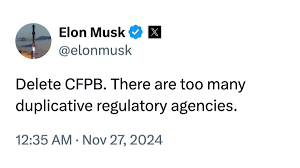
Elon Musk, business leader and owner of the social media platform X, sparked discussions this week with his suggestion to eliminate the Consumer Financial Protection Bureau (CFPB). In a social media post on Wednesday, Musk stated, “Delete CFPB. There are too many duplicative regulatory agencies.”
The CFPB, established under the Dodd-Frank Act in response to the 2008 financial crisis, plays a significant role in overseeing consumer protections in industries such as auto finance and repossession. Its regulations are designed to ensure fair lending practices, address consumer complaints, and monitor compliance in asset recovery.
The bureau’s work includes addressing predatory lending practices, ensuring fairness in loan servicing, and regulating repossession procedures to protect both consumers and lenders. This oversight has been critical in preventing wrongful repossessions and reducing disputes over fees and compliance issues.
If the CFPB were eliminated or significantly restructured, the auto repossession industry could face changes in operational guidelines and reduced regulatory oversight. While some in the industry believe this could reduce operational complexity and costs, others express concern that it might lead to increased disputes and less consumer protection.
The CFPB’s funding structure, sourced through the Federal Reserve rather than congressional appropriations, has been a topic of debate. Earlier this year, the Supreme Court upheld the bureau’s funding mechanism, affirming its constitutionality in a 7-2 decision. This ruling preserved the CFPB’s independent operations, though questions about its long-term role remain.
Efforts to challenge the CFPB’s structure have included legal cases brought by industry groups and state attorneys general. While these challenges have not led to significant changes, they reflect ongoing conversations about the bureau’s place in the regulatory landscape.
Musk’s suggestion comes amidst broader discussions about streamlining government processes and reevaluating federal oversight agencies. Proposals to restructure or consolidate agencies often focus on reducing bureaucracy and improving efficiency, though their potential impacts vary across industries.
For the auto repossession industry, changes to the CFPB could alter key processes, including compliance monitoring and dispute resolution mechanisms. While reduced oversight might simplify certain aspects of asset recovery, it could also increase legal risks and uncertainty for lenders and repossession agencies.
As discussions about the CFPB’s role and structure continue, the auto finance and repossession sectors are closely monitoring potential changes. Stakeholders are weighing the potential benefits of reduced regulatory complexity against the risks of diminished consumer protections and legal clarity.
The CFPB has not yet commented on Musk’s remarks or the broader discussions about its role. The industry, however, remains attentive to any developments that could reshape the regulatory framework under which it operates.