THE CHAINS JUST GOT MORE EXPENSIVE-Epilogue
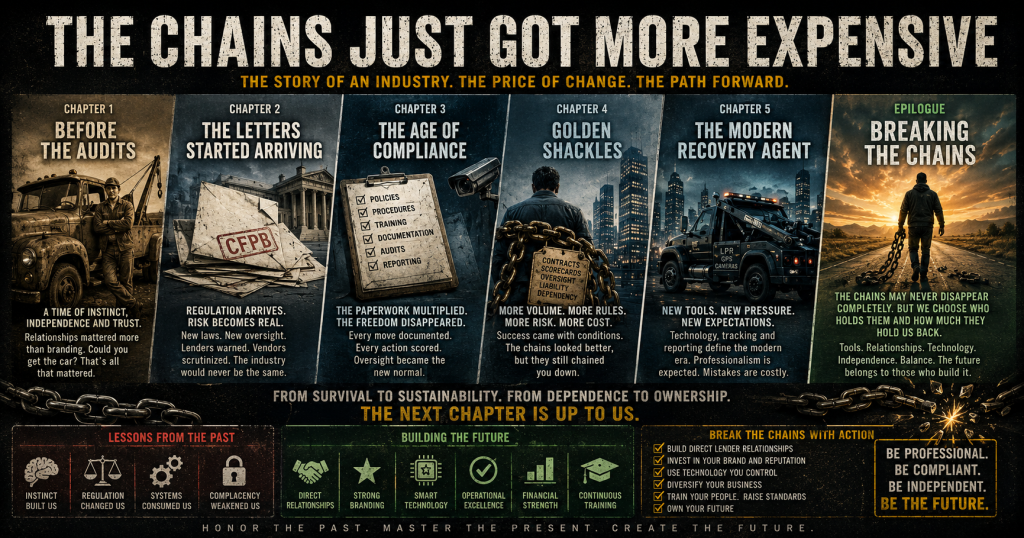
For years, recovery agencies were fed a singular, unyielding narrative about how to survive: more compliance, more oversight, more dependence on forwarders, more vendor systems, and more third-party control. Most agencies quietly accepted this trajectory because they genuinely believed they had no choice. In many ways, the entire industry slowly trained itself to become dependent. They became dependent on national forwarding companies for volume, dependent on rigid scorecards for survival, dependent on software systems owned by outside entities, and dependent on relationships tightly controlled by middlemen instead of direct clients. The sobering result was an industry full of companies working harder than ever while owning less and less of their own future.
But the economic and technological landscape is shifting once again. For the first time in a generation, independent recovery agencies have tools at their disposal that previous owners could only dream of. The future of this industry may no longer belong to the massive conglomerate companies; instead, it may belong to the agile operations that successfully regain control over their own identity, relationships, and daily operations.
Breaking these chains does not mean abandoning professionalism or rolling back safety standards; it means intentionally reducing unnecessary dependence. The agencies that survive long-term will likely be the ones that refocus on direct relationships instead of relying entirely on the crumbs of forwarding volume. Credit unions, local banks, independent finance companies, buy-here-pay-here dealers, fleet operators, and specialty lenders still exist in every market. Many of them are deeply frustrated with layered vendor systems, delayed communication, and a total lack of localized accountability.
In this new environment, relationships still matter, but the crucial difference is that modern agencies now have the digital tools to build those relationships themselves. Through strategic websites, localized SEO, social media, video marketing, industry media, artificial intelligence, automation, and sophisticated digital branding, the game is changing. For decades, many recovery companies operated almost invisibly, carrying no public identity beyond a truck logo and a phone number. Meanwhile, forwarding companies built massive national brands off the backs of the actual recovery work being performed by local agencies.
That imbalance created a cycle of dependency, but the next era belongs to agencies willing to become visible. They are transforming from mere tow companies and low-tier vendors into recognized professional businesses with formidable, direct reputations in their own markets. Technology is effectively leveling the playing field. Artificial intelligence and automation are drastically reducing the administrative burdens that once required large office staffs. Smaller agencies can now seamlessly create training systems, marketing materials, compliance tracking, customer communication tools, dispatch systems, and operational workflows that previously only existed inside enterprise-level organizations. For the first time in years, smaller operators have access to advanced capabilities without enterprise-level budgets, making true independence possible again because small companies can operate efficiently without surrendering control.
However, breaking these chains also requires a profound internal mindset shift. Some agencies became so hyper-focused on surviving audits and scorecards that they completely stopped building actual company value outside of those third-party systems. They built businesses dependent almost entirely on an assignment flow controlled by someone else, a model that creates permanent vulnerability where a single contract loss can cripple an operation overnight. The agencies building durable futures will diversify their relationships, strengthen their own branding, invest in technology they control, and create businesses capable of surviving beyond a single forwarding platform or lender relationship.
Professionalism, compliance, and rigorous training still matter immensely, but there is a vast difference between being professional and becoming completely controlled. The ultimate goal should not be returning to the wild, unregulated chaos of the old days, but rather achieving a sustainable balance. This means fostering professional recovery companies that remain compliant without surrendering independence, and building modern operations that utilize technology without becoming trapped by it. The industry spent years learning how to be compliant vendors. The next generation may finally decide to become owners again—owners of their reputation, owners of their relationships, owners of their technology, and owners of their future. The chains of the industry may never disappear completely, but recovery agents can finally decide exactly how much weight they are willing to carry.